Saturday, July 6, 2013

18 – Where I work

You already know that the port site is at least 15 km (10 miles) from the apartments.  That's a 15-minute commute, and there's never any traffic.  OK, maybe two trucks.  It's a boring drive, however.  Sand is just not that interesting after you've done it three or four times.  Here are some of the highlights of the drive.

Sand.  Vehicles on the horizon about 1/2 mile away.

More sand, and -- OMG! -- a bush!  Our KAEC apartments are on the left horizon about 5 miles away.
There are workers out here, amidst the sand, installing irrigation for palm trees and some sort of ground cover in the median.
The picture below is the best I could find about how the port is getting built.  I haven't really taken any pictures of construction because there has been a confidentiality requirement for the past year.  This morning (Saturday) I was told it's OK to post photos of the job site, so I'll be burning up electrons making my digital photos.


KAP, looking south.  The Red Sea is to the right, sand is to the left.
The color balance is off in the photo above, but it shows a couple of important items.  There are two dredges working the top center and left edge of the basin.  These big ships have gigantic drill bits in their bows that stir through the soil and get it all agitated in the water.  They also have giant suction pipes that continuously suck water and suspended silt out of the basin, and send it (slurry) flowing down the pipelines attached to their sterns.

Blue clamshell
Both dredges in this photo have their slurry pipes converging at the shoreline, where a pipe runs diagonally towards the bottom of the photo.  The slurry is carried to the end of the pipe, where it's dumped on the ground.  The water evaporates (probably in ten minutes here) and the sludge begins to build a small mountain.  The exit end of the slurry pipe is moved every few days, and the KAP dredges have managed to build quite a mountain range over the past year.  (Not tall enough to ski, but we're not through dredging.)

You can see the nice circular slices made by the dredges.  They're pinned in place by hydraulic jacks on their sterns, and pivot slowly back and forth until they've dredged to the 18m (60 feet) depth required for this project.

The other vessel (upper right) is a barge-mounted clamshell.  It's been used to remove soil above the waterline so the dredges can start digging below the waterline.  The past few days, it's been working on the bottom right corner of the photo, smoothing out the edges of the quay.

STS crane.  Note people walking.
There are two types of cranes used in a port.

Ship-to-Shore cranes lift containers off the ship and place them on a 'terminal truck' to be hauled to the temporary spot it will inhabit on the yard.

Our STS cranes were purchased from Liebherr in Germany and shipped in a state of "some assembly required". 

We have three of them, and each can lift a 65-ton container.  I have no idea how tall they are, except "real".  As in "real tall".  They're custom painted with "King Abdullah Port", too.  Sweet.

The lower photo provides some scale, and shows the two other cranes that are helping assemble this one: STS-04.

Like I said, we have three of these, and the rumor is they're the biggest in the world, but Liebherr is building two bigger ones that should be commissioned in December.

Oh yeah, that grey box at the top?  That's the operator's cabin.  It's big enough for three people and has a bathroom.  As you can see it's larger than the Chevy Suburban at the bottom of the crane.
STS Crane from far away.

The other type of crane is the Rubber-Tired Gantry, or RTG.  We have 22 of them on site, with 2 assembled and the others lying in neat rows of pieces.

RTGs move around the multi-acre container yard, picking containers off the terminal trucks and placing them in the correct space, on the correct row, on the correct aisle, on the correct level above the pavement.  For contrast, the STS rolls on railroad rails at the edge of the wharf and never leaves the quayside.

Our RTGs are capable of "one over six" which means our container stacks will be six tall, and the RTGs can place a container on the seventh level for a temporary move to fetch one from underneath.

So, you can see that the real effort in port management is to have an idea of which containers will sit for a while, and which are destined for pickup tomorrow.  The stacking scheme should attempt to eliminate (or at least minimize) shuffling and re-stacking.

One of my high points was touching the Red Sea.  Geeky, yes, but I've touched a lot of the world's bodies of water.  I was wandering around with one of the Beirut techno-guys.  We know each other from his visits to Boston.  He had no idea I knew anything about seaports so we wandered around looking at things with him asking questions.  I was headed toward the water, and he decided to join me.
Our cute little 4-story-tall RTGs standing behind their BIG brother.
We got to the revetments; the shoreline protection against storms and wave action.  I told him I was headed across the rocks to touch the Red Sea, and he said, "OK, I'll watch."

The rocks close to the water are the size of La-Z-Boy recliners or coffee tables, and presented little hindrance to me scrambling across them and down eight feet.  As I squatted to reach my hand into the water, I looked up and there was my buddy, only a few feet away, reaching for the sea.  "When I saw you doing it, I wanted to touch the water myself."

Cool to share a moment like that.
Revetments stacked on rocks between Saudi Arabia and the Red Sea.
These revetments are a variation on the venerable tetrapod.  They look a little like jacks -- you know, the childhood game of bounce the ball, grab some jacks?  These are H-shaped in one plane, with a toothpick stabbed perpendicularly though the H's cross member.  The shape allows them to interlock and provide exceptional protection against wave forces.

Over a few years, the rocks and revetments will sprout seaweed, which will attract little fish, crabs, and other small sea creatures.  A few years later, the bigger fish will start hanging out, and pretty soon you have a nice marine community going.  Makes for good fishing, too.

Next: More pictures of the port.  Or maybe pictures of the office.  Or maybe more pictures of sand.


17 – Where I live

My apartment is located at lat 22.40474, lon 39.07697.  You are welcome to follow along on your own Google Earth screen.
Most construction in the King Abdullah Economic City isn't yet visible on Google Earth.  KAEC (pronounced "CAKE") is about 80 km (65 miles) north of Jeddah.  (Arabic uses glottal stops, so Jeddah is pronounced JED-duh, almost like two separate words.)  In the map below, Jeddah is 1/4 inch below KAEC, where a pair of little 'horns' jut into the Red Sea.
Google Earth is GREAT!  Note scale in lower left.  Click for bigger photo.  (Slightly bigger.)

Below, zoomed in a little, you can see Highway 5 that runs northward from Jeddah to KAEC, and beyond to Rabigh, the nearest city.  Rabigh can easily be found on Google Earth, and is pronounced ROBB-ick, except make the nastiest ch/ck sound possible at the end of the word.  Think angry evil German dude.  As a matter of fact, because of a few sounds like this, Arabic speakers often appear -- to me -- as if they're about to break into fisticuffs.
Jeddah, Mecca, and KAEC

I called Mom on her birthday from a street corner in Rabigh; well, it was July 3 in Rabigh, anyway.


Happy Birthday, Mom!  As is often the case,
the photo doesn't capture the full scope of the scene.
The picture below is the environs of KAEC.  This is the residential and office section only.  The industrial and port sectors are 15 kilometers farther north.  The lower Water Canal is for the superyacht marina; the upper section is just aesthetic, to bring the unbelievably turquoise water into the office district.  The Crescent and Star mark the bigger of the two city mosques.

No boats in the marina yet, although some are expected before I leave

My apartment is fully 15 km from the port site -- King Abdullah Port. (pronounced KAP.)
There's nothing but sand here.  I am not exaggerating.  (Blue squares are photos available on Google Earth.)
We have about 20 engineers and managers on the team, and five or six cars: Hyundais, Renaults, and a Chevy Savannah 12-passenger van. I do not have, nor do I want, driving privileges.  Our clients are a trio of consultants for the King: an Englishman from Newcastle (Malcolm), an Aussie (Alistair), and a Greek (Leonidas).
Most of our team is Lebanese (our Beirut operations group) and all but me speak Arabic fluently.  All speak English fluently, too.  Almost all live in company apartments in KAEC, although a few have elected to stay in a hotel in Rabigh.  The tradeoff is activity and access to stuff in Rabigh, but much lower quality accommodations and a 35-minute commute each way.
I have worked with a few of the team before, when they've come to Boston for projects.  They're all pretty funny, and half are US educated.  Despite being Arabic cousins to Saudis (and at least one a devout Muslim) they cannot help but find humor in the strict customs here.
Us KAEC dwellers live in brand-new apartment block B on the Red Sea. 
Pretty sweet, eh?
I share a two-bedroom apartment with views away from the sea (no setting sun in our windows).  My roommates are Marlon (24, Costa Rican, recent mechanical engineering graduate from King Abdullah University of Science and Technology) and Daniel (Pakistani, 24, recent electrical engineering graduate from KAUST) who have been buddies for a while.  They share a bedroom but have a private bathroom each; I get the bigger bedroom with the ensuite bathroom.
[aside]  While Saudis heartily endorse equality in general, they do not do so in practice.  Reminds me a great deal of the South in the 50s and 60s.  Today, in Saudi Arabia, I am a white educated American, and always get the front seat in the car, the first crack at communal food, the best seat at the conference table.  This is leavened, of course, by other hierarchies of power: our client, our senior project managers, and potential Saudi customers are ranked higher than me.  After a lifetime of turning down preferential treatment, it is taking me considerable effort to acquiesce.  Why acquiesce at all?  I suspect an egalitarian arrangement would insult my hosts.
da beach during da night.
Here are shots of the interior.  Please understand that I have two kids as roommates.  I'm hereby blaming all the visible mess on them.
 
Tub and shower with sufficient counter space
The bathroom is quite nice.  Excellent ceramic tile and glass.  Fixtures are verrrrry nice.  Toilet is tucked under the counter a bit, though, and the shower head aims directly at the glass door ensuring a wet floor.
Perhaps that's not a big deal here; they hose down the floor, remember?

Not much furniture, but it's a comfy mattress. Picture of my boys on the windowsill, and one of brothers, wives, and cousins from Mom's most recent birthday  

All of the furniture and fabric items are from IKEA.  Struck me as funny.  There are big built-in closets, a maid's room, and one machine that's both a clothes washer and dryer.  Will be testing that out tonight.

Three guys, and two of them are twenty-somethings.  What do you expect?

Living room with very effective "window blinds"
 

The living room is an interesting thing that says volumes about my roommates.  They assembled the IKEA furniture, but saved the boxes to cover our two large living room windows.  They 'borrowed' two additional unassembled couches in boxes to lean against the windows and further block out the light.  This is important since they (we) watch movies using a hand-sized projector.

This, my friends, is a BIG television screen.  Can you imagine Georgia Tech football this big?

Stereo and iPhone playing Radio Paradise


The digital movie is streamed from an external hard drive, through a PS3 game console into the projector (video) and stereo (sound).  The video is projected on the opposite wall, producing a picture 12 feet wide and 8 feet tall.  My second night here, we watched a Pirates of the Caribbean movie, and when Penelope Cruz appeared life-size on the wall, I almost fell out of my chair.


The boys were impressed when I shared my audio setup: a deactivated iPhone (no cellular service) streaming Radio Paradise through the wifi connection and pushing it through the stereo.  They were also impressed that I listen to rock music, but when I reminded them I'm an American, they sagely nodded and said, "But of course!"


The last photo is pretty telling.  There are Drivers Accommodations in apartment block B.

Aspirations for a second career: driving a Rolls Royce, a Bentley, a McClaren, or slumming in an Audi S8.

Ramadan starts tomorrow.  That will change things.

Next: Where I work.

Friday, July 5, 2013

16 – Miscellaneous Photos

Text can be soooooo boring.  Let’s take a look at some photos!

 
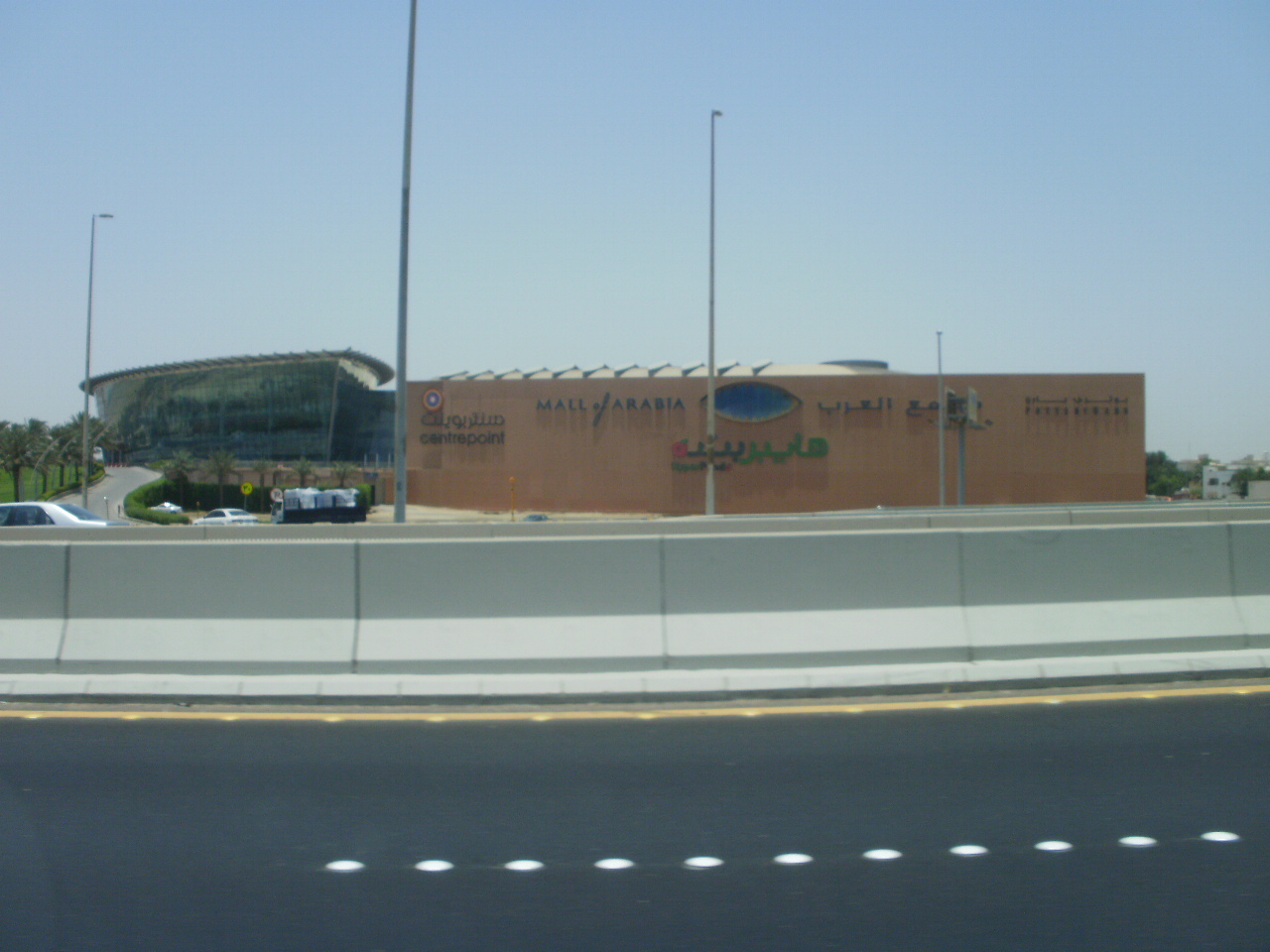
Malls are everywhere.  Haven't been in this one, but I bet it looks like all the others in the world.


Note text in RED for EMPHASIS:  DEATH FOR DRUG TRAFFICKER.

Written Arabic is indecipherable to me.  Like Greek, Japanese, Chinese, and Cyrillic, its alphabet has nothing In common with English.  Did you know it's read from right to left?  Why, of course you did!


"Minor sandstorm", he said. "Hardly worth slowing down."  Even with reduced visibility and blowing sand?


Video of the "minor sandstorm" -- make sure to maximize the picture


Turn?  Straight?  Exit?  Honk?  No lane lines, so drive wherever you want; just honk a few times.

King Abdullah


King Abdullah Sports Complex, just outside of Jeddah
STOP!  Enough already!
OK.  King Abdullah is indeed the king.  Actually, "Abdullah bin Abdulaziz bin Abdulrahman bin Faisal bin Turki bin Abdullah bin Muhammad bin Saud, Custodian of the Two Holy Mosques", is the King of Saudi Arabia.  He's 88 years old (in 2013) but only ascended to the throne in 2005 when his brother, King Fahd, died.  (Yesterday there were rumors King Abdullah's comatose or functionally dead.) 

The royal family is descended from Abdul Aziz bin Saud who starting conquering neighboring tribes on the Arabian peninsula in the early 1900s.  He unified almost the entire peninsula by 1932, when the kingdom came into being.  The royal family owns everything that hasn't been sold into private ownership.

That means the vast expanses of desert, under which hides almost 25% of the world's oil reserves.

Like most Kings he wants to be remembered.  One way is to build a big soccer stadium in the nation's second largest city, build a port from nothing, and build an economic city in the middle of the desert.  Another is to send bright young people to college for free: like Marlon and Daniel, my roommates, and Faisal from Jeddah, my seatmate on the Munich-Riyadh-Jeddah flight.

All three got engineering degrees, completely free, with no obligation to the King or Kingdom, from the King Abdullah University of Science and Technology.  Locals -- like me, now -- call it KAUST.

And the stadium, city, and port are required to employ a minimum of 15% Saudis and to purchase local materials if they are available.

That's a nice way to be remembered.

15 – At The Villa

From our roof: a compound across the street
The villa is a three-story, five-bedroom compound.  Yes, it’s a compound; the building is surrounded by a ten-foot tall concrete wall.  You enter through a heavy wrought iron door with frosted Lexan inserted between the wrought iron layers.  It slams solidly enough to make you careful about finger placement.  This is what Rasheed led me through after we arrived.
 
From our roof: a compound across the other street
Just inside the door is a brick courtyard large enough to park two cars – which is what it is designed to do.  The steel ‘garage door’ is the kind that rolls up and down, very like commercial storm shutters or the things shopkeepers pull down in front of their store windows in the sketchy parts of a city.  Two large canvas umbrellas suspended from steel frames provide shade to cars parked within the compound.
  
We climb three steps to the double-leaved front door with colored and frosted glass. A polished marble floor, marble stairs, ornate wrought iron bannister … it’s an amazing blend of niceties and strangeness.

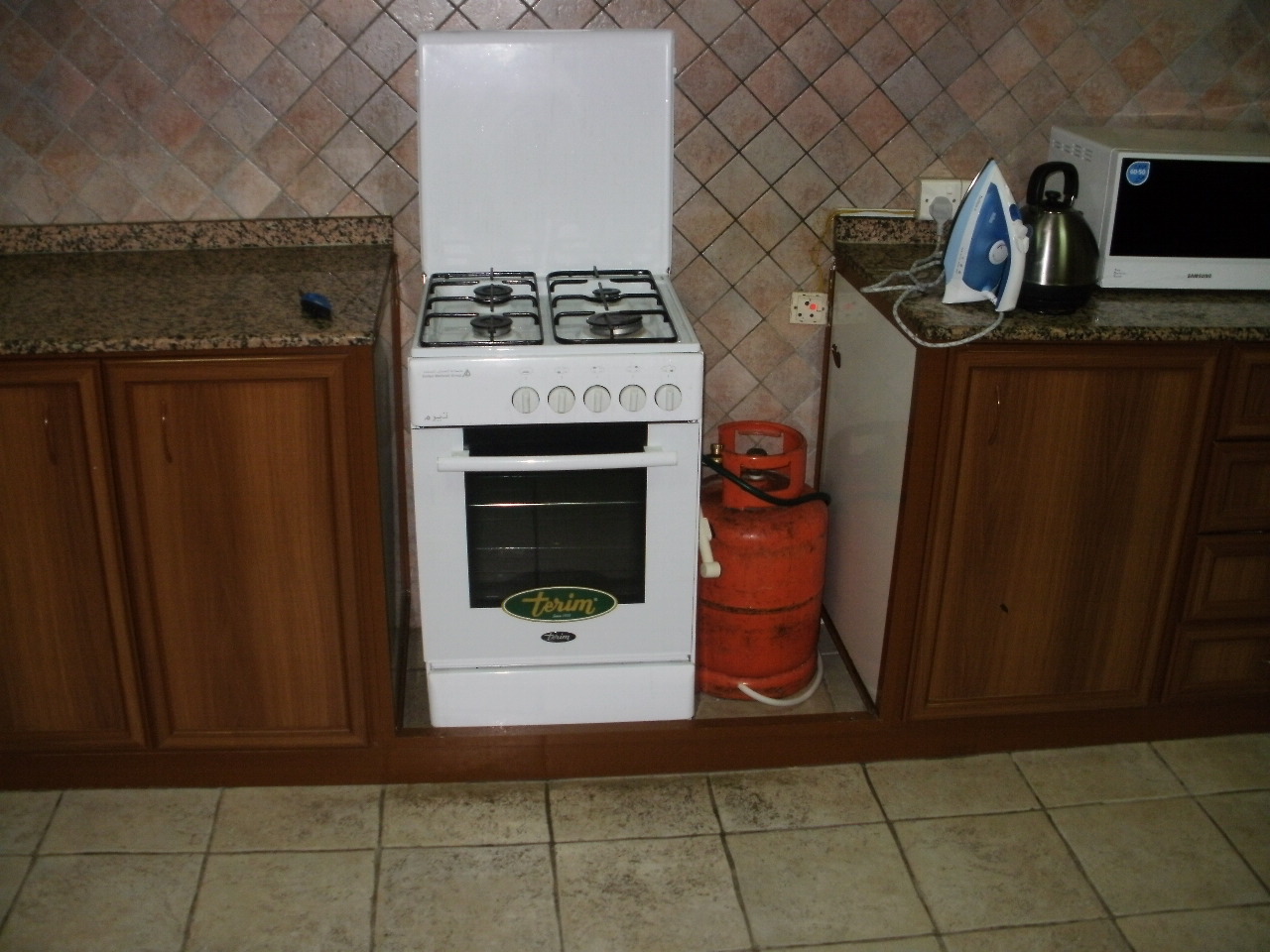
The materials are incredible; the workmanship less so.  And all the details are slightly off: light switches flip down to turn on, air conditioning is by internal units above the door to each room (with remote controls), the range fits into half the slot in the kitchen counter because the propane tank needs room, the bathrooms have bidets and floor drains covered by chrome disks.  Bathrooms are cleaned, I later learn, by hosing them down through the drain -- even bathrooms in a home.

Entry to the villa
I had arrived with no Saudi riyals.  My bank had warned of excessive fees when doing business in KSA, and of the $5 flat fee for ATM withdrawals, no matter the sum withdrawn.  Hey, I decided, let’s have an adventure looking for an ATM!  My bank suggested using the RiyadBank, since they are somehow affiliated.  Google said the nearest RiyadBank ATM was about 1 km from the office/villa, and my first Saudi adventure was planned.  

Except that after work that evening I went back to the villa, checked Boston emails and, terribly jet lagged, fell asleep.

Cooking with gas!
Woke up about 10:45 and immediately was concerned about making the walk at that hour and – more importantly – being too late to find food.  About that time, two guys from the office walked in the villa’s front door.
“Walking in Saudi is dangerous only from the standpoint of getting hit by a car.  There’s negligible crime here.”

I’m about to find out.
  
Outside was like a sauna, but not unlike the Southland in summer.  Got my bearings quickly and set off.  My hiking reflexes made me note the time:  11 pm.
  
The Danube (a Jeddah-based grocery store chain) was at the end of the block, and it was hopping.  Busy as could be, with cars and pedestrians darting every which way.  I turned left at the corner and headed northeast on Hira Street.  There was a strip of restaurants adjacent to the Danube, and they, too, were hopping.  Starbucks, Roody’s, Baskin Robins, and two or three chocolate shops.
 
Danube and Jeddah from the office: looking away from the Red Sea
Auto traffic was thick and horns were honking from all directions, but not at me.  I checked my watch again: 11:10.  It’s dark, so that would be 11 pm – this was a little confusing, and I force myself to think extra slowly when I am confused.  (Can we blame that on jet lag?  Thanks!)
   
There’s not really a sidewalk on Hira Street.  Some stores and buildings have sidewalks, but it’s intended to be a convenience for customers coming to visit that building, not as a corridor for walking along the street.  The piecemeal sidewalk is not lighted.  Each section is at a different height, from a inch or so difference to as much as two feet.  This is not walking to the ATM, it's hiking.
  
So I stumble along across parking lots, empty lots of sand where there is no building or sidewalk, step up and down to sidewalks where they exist, and clamber across utility pipes.  Strip shopping centers, vilified in the US, are welcome on this  walk  hike: they have level, wide, well-lighted sidewalks.  I pass high-end stores selling designer labels (the big stores are legit, the small shops are counterfeits) and stores selling high-dollar furniture, lighting fixtures, and chocolates.  I pass many cars parked halfway onto the sidewalk, an improvement over the cars parked in the right hand travel lane back at the Danube.  I pass a Bentley pulled diagonally onto the sidewalk with his windows rolled down and six feet of car sticking out into the street.
Typical street: fast lanes left of the concrete separator with occasional access, park wherever you want, and, of course, there no sidewalks
Everybody’s honking their horn like it is a status symbol.  Thawbs and burkas are on 98% of the people walking around, there are a lot of people walking around, and it's almost midnight. 

The RiyadBank is closed.  Not like “Too late, sorry; come back tomorrow.”  Like locked, windows papered over, plywood where the ATM was located. 

No problem.  I’d passed at least two ATMs on the way.  “Let’s turn around, and get some cash at the first available ATM.  Tomorrow will be too busy to get to the bank.” 

There were a couple of guys hanging around the ATM.  I noticed them from a block away, but soon realized they were waiting for a man and his son who were inside.
……………………………………………………………………………………………………………………………………
The three men and the boy all had on thawbs (pronounced THOBB), which can be as fancy as the burkas mentioned in an earlier chapter.  Embroidered cuffs and plackets, Nehru-style collars, hidden or exposed buttons. 

The men also had traditional Saudi hats: a ghutra.  Other Arabs wear kufis, which are beaded skull caps.  Ghutras come in the traditional white (sometimes textured or with sublimated patterns) and the checkered style alá Yassir Arafat. 

Thawbs look pretty snazzy, actually, because they’re starched and bleached white-white, just like the plain white dress shirts I prefer.  Ghutras look like very practical headgear; the excess can be used to wrap your face to keep out sand or sun.  I'd look pretty cool in Saudi threads.
……………………………………………………………………………………………………………………………………

Fish killer
 
The minimum withdrawal is $500 SR (about US $125), so that’s what I got.  Stopped at the Roody’s fast food joint to honor one of my daughters-in-law, and was confronted with non-English speakers.  At least that’s what they said.  They were watching a big public rally with lots of chanting on TV, and simultaneous camera views from at least six different cities.  Perhaps they didn’t want to converse with an American while watching an anti-USA rally on TV.  (You do know about my paranoia, right?)
 
Ordered an Arabic Shawarma – which came with the universal side dish of fries – and two cans of Mountain Dew.  Walking in a sauna at midnight will work up a thirst.  Food was good, service was good, TV was interesting, and cans had pop tops that removed from the can.  Haven’t seen those in thirty years.
 
Exhausted, I fell onto the bed fully clothed and slept until 8 am.

Sunday, June 30, 2013

14 – Journey to Jeddah, chapter 2

Happens to me every now and then: easing down the aisle with my carry-on held carefully to avoid bumping people, counting rows, searching for the empty seat that will be my little home for the upcoming flight, and … somebody’s already in it.

Now, I asked for a window seat on this trip because I want to stare at some of the largest deserts on the planet.  I’m a map geek; aerial photos and Google Earth quicken my pulse, and this is my first trip to the Middle East, and parts of Saudi only get a couple of inches of rain every TEN YEARS, and, and, and, and someone is sitting in my spot.  My heart sinks, because I see the family stretched across six seats and I’m not a homewrecker, even when the definition is stretched to fit this situation.

Since I don’t speak Arabic, I spin back toward the flight attendant and relate my issue.  I tell her I’ll give up my valued window seat and sit where the inerloper should be sitting, if someone identifies the interloper’s seat.  “But you have to ask because I don’t speak Arabic and the interloper’s a woman in a burka.”

I got moved one row back on the inside of the port aisle.

Stashed everything except my book and my passport (believe me, that passport isn’t leaving my possession until I get back through immigration at Logan Airport) and found the emergency exit card to study.  Before 90 seconds have passed, the flight attendant returns and asks if I might like to follow her.  “Uh, OK.”  Dumb question.
I did not propose marriage.
My beautiful German flight attendant speaks Arabic and English flawlessly, has a great smile, and is comfortably beyond 40 years old.  I’d follow her anywhere, and I suppose it’s pretty obvious that I would do so.  (Her black hair and olive complexion are because she’s half Portuguese – but that's another, much longer, story.)  She smiled warmly and said, “I was saving this one just for you!” and pointed to an empty window seat on an exit row with 6 feet of leg room!

Profuse thanks in English and German – except I probably said “Thank you, sir” in German.  Gotta study that emergency exit card again, because now I’m responsible for several hundred passengers and I will NOT disappoint my newest favorite flight attendant if things get dicey.  Yeah, Jason Bourne's got nothing on me, baby.

The plane has one of those “you are here” computer-updated maps, and I follow the plane’s circuitous route to Riyadh.  We definitely stayed outside of Syria, and I am sure it was intentional.  The Jason Bourne side of my brain started wondering, “Exactly how dangerous is it to be flying in a Euro airliner over the Middle East?”  I settle on, “Better than being on a US carrier,” and accept that it’s too late now to change things, anyway.

Riyadh appears after a half-hour of sand: brown, tan, orange, beige, eggshell and all the shades in between.  I mention the white-capped mountains to my seatmate – Faisal, a Saudi from Jeddah – who assures me it’s not snow, but powdery, white (surprise!) sand.  I realize the plane’s been going about 500 mph during that half hour, and wonder what living things might survive in 250 miles of sand.  I mean, even with the occasional rock, that's a mind-blowing amount of sand.

Even if I described it faithfully and accurately, you wouldn't believe me.
A dozen women hit the bathrooms during the hour before we land in Riyadh.  They go in with a dress and come out with a burka.  Faisal assures me it’s cultural and no one sees it as hypocritical.  These women understand the way the game is played: wear your burka in Riyadh, and holiday in places where you don’t have to.  Seems they’re all traveling with their husband and three or four kids, which means they’ve given some hefty money to Lufthansa, and I begin to understand.

If life sets you up pretty nicely in Riyadh, you make some sacrifices to enjoy the benefits accruing to your family -- in Riyadh -- and elect to stay there even if that society's rules are oppressive.  

I suppose most of us make similar choices.  Wonder what those women will do when the kids are grown and gone?  Who knows.  By then they will be very different people.

Riyadh came and went, and took 80% of the passengers and 100% of the sunlight.  The flight crew relaxed, us passengers relaxed, and we flew over the dark Saudi desert for an hour to Jeddah.

Rough landing, and a couple of airport guys pushed stairs against the plane.  I stepped out into hot humid air – very like flying into Tampa or Houston.  We climbed on a couple of buses for the five minute ride to the terminal, and I was struck by the placards that said, “seating for elderly and women only.”

Passport control: passport guys in olive drab, soldiers in powder blue with red berets and pistols.  There are only men in the “Diplomats and Business” line.  However, that same line holds a very wide assortment of tunics, thawbs, pantsuits like pajamas or surgical scrubs, terrycloth towel wraps like togas, bare bellies and shoulders peeking out from the togas, taqiyahs, ghutras, and everyone wearing sandals.  Well, almost everyone.

All alone, there is me: bareheaded in blue jeans, boat shoes, and a button-up shirt with a button-down collar.  I tried very hard to be inconspicuous.  Yeah.  It wasn't working.

The only women I saw were the occasional parade of a flight crew.  Everything else was so strange, it took a while before I noticed that there weren't any women around.

Forty-five minutes later, a little after 11 pm, the gentleman took my passport, took all ten fingerprints, took a photo (“Glasses off!”), and asked to see my boarding pass.  The heavy stamp clunked down on my passport and I went to find my baggage.

The company driver  -- a company driver?!?! -- met me just outside baggage claim.  (The general public is not permitted to enter baggage claim or the arrivals terminal at King Abdulaziz International Airport.)

Jet-lagged view out the windshield.  Exit here or not?
We began our trip into the city, and Jeddah is a big city with a population of about three million.  We drove for at least 45 minutes through heavy traffic with crazy people everywhere and more honking than a flock of geese headed south for the winter.  Familiar logos with squiggly Arabic letters marked outposts for Baskin Robins, Dunkin Doughnuts, Pizza Hut, Pepsi, and (OMG!) Krispy Kreme.  Purple and pink neon is everywhere.  Guys were washing cars in the parking lots as their owners were shopping or dining.  Thousands of cars.  Don’t these people know it’s almost midnight?

All of a sudden, Rasheed the driver said, “Hold on!” and we swooped a right-hand turn from the far left lane, veered across two lanes of traffic, honked at a car waiting for a parking space, and careened into a very dark street.

“That’s the office,” he shouted over his shoulder as he looked out the window to make sure we avoided the concrete median.  “And here’s your villa.”  He pulls up on the left sidewalk at an ornate wrought iron gate in a nondescript 8-foot concrete wall.  A steel storm-shutter garage door was adjacent.  Before I could process his words (24 hours on a plane, remember?) he popped the trunk and grabbed my bags.

“You’ll like it, sir.”

Friday, June 28, 2013

13 – Journey to Jeddah, chapter 1

The trip to Jeddah started auspiciously.  The taxi dropped me at Logan’s Terminal E about an hour and ten minutes before departure.  A Lufthansa representative greeted me at the ticketing kiosk and pushed all the buttons to get my boarding passes.  I stepped up to the counter to check my bags (two checked bags = $zero) and a nice young man performed the actual ticketing and bag checks.

Immediately after issuing my tickets and baggage claim stickers, he said, “Let’s get you to the boarding gate.  Please follow me, sir.”
 
He then led me past the crowd of people in the first class security line, flashed his badge at the passport checker, and placed me squarely at the front of the line.  After the Homeland Security dude performed his perfunctory 30 second perusal, my Lufthansa guide led me to the front of the ‘take-off-your-shoes’ line.  After a quickie X-ray check, we took off for the gate.  He said, “Looks like you can walk fast, so we won’t need a cart.”

"Multi-Pass" for Munich to Jeddah
Booyah!  Less than five minutes after issuing my ticket, I’m standing in the boarding line at gate E7B.  Was that a miracle or what?
 
I love Lufthansa!  Head of the line twice, two checked bags cost zero, two glasses of red wine cost zero, fabulous cups of coffee until I couldn't hold any more, dinner, breakfast, a couple of snacks, a screening of Identity Theft and Don’t Trust the B in Apartment 23, and we landed in Munich.
 
Two brave and beautiful girls sat beside me: Aria is 10, Aya is 5, and they were flying to see grandma and grandpa in Sarajevo.  Aria confidently informed me that she’s done this a lot, since their grandparents live in Bosnia.  They appeared unaccompanied, so I happily adopted them.  We had some fabulous conversation (and silly stuff) before Aria announced it was their bedtime and arranged the two of them to rest on each other, under nice (and also free) Lufthansa blankets.  My newest lady friends had chaperones, though: two well-worn bunny rabbits, one of which talked, and a small fuzzy cow.

==========================================
 
Flughafen Munchen (does that rhyme?) provided both wonderful and disappointing experiences:


a)  Lufthansa offers free newspapers and magazines to passengers.  Almost took a few even though they are German language.  Mom can once again tell the story – because she tells it so well! – about my German 101 final exam.
 
Der Spiegel, anyone?
b)  Even though I wasn't entering Germany, the pleasant German passport control guy stamped my passport with no hassles without leaving the secure area.  I'm finally getting some stamps in my four-year-old passport.
 
c)  There are LOTS of Americans.  Someone should tell them this is Germany, and I want to see folks not from the US.  The older gentleman sitting directly across from me at the moment is wearing a North Carolina Tar Heels cap.  He is oblivious to my Georgia Tech bag tag, probably because I’m an American and he, like me, only wants to see foreigners in this airport.
 
d)  They served me a Spaten at 10:30 in the morning.


Cannot take photos of women, so, thanks internet!
There are lots of Arabs at the gate, but that’s not a surprise since the flight goes to Riyadh and then to Jeddah.  I’m practicing the art of ignoring women in burkas, but it’s hard because they look so much more unusual in person.  Imagine being immersed in a Kung Fu movie with ninjas, since ninjas also wear black cloaks and head coverings with only an eye slit.

If you think burkas are plain black shrouds, like I did, you're wrong.  Some have muted dark colors, like purple, grey, or navy blue, but almost all have delicate embroidery, glittery beading, shiny piping at the seams, or other adornments, and none of it is subtle.  Some of the women wear almost opaque veils with draping pieces to cover their necks and throats, while others wear small veils that cover very little of their faces.  And some wear perfume -- wonderfully smelling fragrances that rival what I'd expect to smell at a Boston Symphony performance.

Not at all what I imagined about burka wearers.